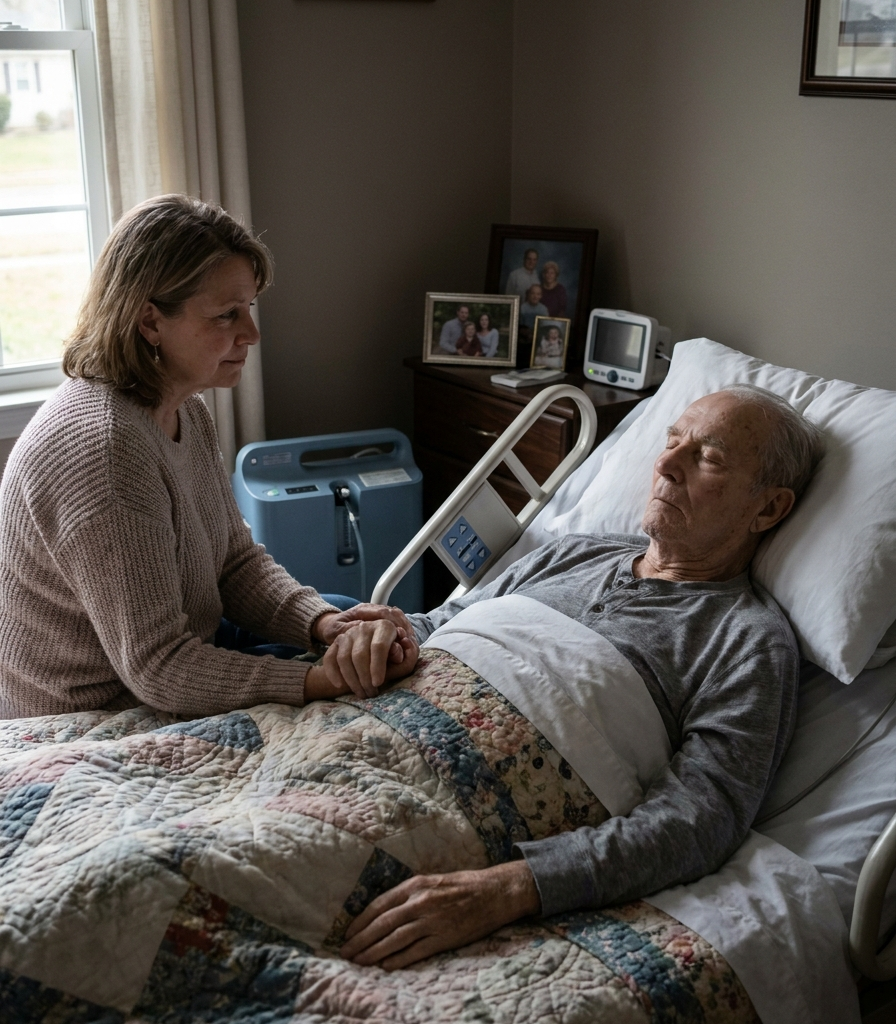
Caring for a dying parent at home is one of the most profound things a person can do. This guide walks through what that actually looks like: the medical, the logistical, and the deeply human parts that nobody warns you about.
There is a moment that many caregivers inevitably go through. You’re standing in the kitchen at 2 a.m., making a cup of coffee, you realize you can’t remember the last time you slept more than three hours in a row, you’ve cancelled every plan you had for the past four months, and you begin to forget who you are outside of the caregiving role.
Nobody tells you about that moment when you decide to bring a dying loved one home. They tell you about hospice referrals and hospital bed rentals. They don’t tell you that caregiving can quietly hollow you out if you don’t protect yourself while you’re protecting someone else.
This guide is for people who are already caregiving, or who are about to be. It covers the practical realities of home-based end-of-life care, the medical equipment, the medication management, and all of the physical demands, all encompassing the true question of how to care for a dying parent at home without losing yourself.
What “Caring for a Dying Parent at Home” Actually Means
Before anything else, it’s worth being honest about the scope of what home-based end-of-life care involves. This is not the same as helping an aging parent with grocery runs and doctor appointments. It is far more intense and full of physical and emotional labor. It can be compared to a full-time job with no shift changes, no paid time off, and, more often than not, no coworkers.
Depending on where your parent is in their illness, caregiving can include:
- Administering medications on a schedule (sometimes every few hours, including overnight)
- Managing pain through oral medications, patches, or subcutaneous injections
- Helping with bathing, dressing, and toileting
- Repositioning someone in bed to prevent pressure sores
- Monitoring breathing patterns, skin color, and level of consciousness
- Communicating daily with hospice nurses and on-call teams
- Managing household logistics like meals, laundry, and medication refills alongside all of the above
None of this is insurmountable. People do it every day. But going in with clear eyes about the demands allows you to build the right support around yourself from the start, rather than scrambling when you hit a wall three weeks in.
Setting Up Your Home for End-of-Life Care
Work With a Hospice Team From the Beginning
If your parent qualifies for hospice care, which generally requires a physician’s certification that life expectancy is six months or less if the illness follows its expected course, enroll as early as possible. This is the single most important practical step you can take.
Hospice is not “giving up.” It is a shift in focus: from curative treatment to comfort and quality of life. And critically for home caregivers, hospice brings an entire team to you: a registered nurse who makes regular visits, a social worker, a chaplain if desired, a home health aide several times per week, and on-call nursing support around the clock.
Hospice also covers the cost of medications related to the terminal diagnosis, medical equipment, and supplies, meaning hospital beds, wheelchairs, commodes, wound care supplies, and most prescription medications come without out-of-pocket cost under Medicare’s hospice benefit.
If you are not yet working with a hospice team, ask your parent’s primary physician for a referral now. Many families wait until the final days. The ones who enroll months earlier almost always say they wish they’d done it sooner.
Arrange the Physical Space
A hospital-style adjustable bed is essential for anyone who is largely bedridden. It allows the head to be raised for eating and breathing comfort, and it makes repositioning someone significantly easier on both your loved one and your back. Hospice will typically deliver and set this up for you.
Beyond the bed, think about:
Proximity. Ideally, the caregiving space should be on the main floor if possible, close to a bathroom, and accessible from the front door for medical visits. Many families convert a dining room or den.
Safety rails and mobility aids. If your parent is still mobile but unsteady, grab bars in the bathroom, a shower chair, and a raised toilet seat dramatically reduce fall risk, as falls are one of the most common and serious complications in home care.
Noise and light. As someone approaches the end of life, their senses often become heightened or conversely, they become more sensitive to stimulation. A space that can be made quiet and dim is a gift.
A comfortable chair for you. You will spend an extraordinary number of hours in that room. This sounds minor; it is not.
Medication Management
Pain control is the central task of end-of-life care, and managing it well requires organization. Medications are often prescribed on overlapping schedules. Some for baseline pain, others for breakthrough pain, others for anxiety, secretions, or nausea.
Create a written medication log that travels with you the patient’s chart and is updated at every administration. Track the time, the dose, and any noted effects. When the hospice nurse visits, this log is your most valuable document. When there’s any new changes, a new symptom, a medication that seems ineffective, a side effect, the log tells the clinical story.
Keep medications in a single organized location, labeled clearly, with a copy of the dosing instructions attached. As the patient’s ability to swallow changes, liquid formulations or sublingual drops replace oral tablets; the hospice team will make these transitions with you.
The Physical Demands of Home Caregiving
Body Mechanics and Injury Prevention
Back injuries are the most common physical consequence of caregiving, and they are largely preventable. Before you attempt to reposition, transfer, or bathe someone who cannot bear full weight, ask the hospice home health aide to show you proper technique. This is very important, and the difference between caregiving for three months successfully and caregiving for three months with a herniated disc.
Specific techniques to learn:
- Log rolling (turning someone in bed without their full participation)
- Using a draw sheet or slider board for repositioning
- The proper pivot transfer from bed to chair
- Gait belt use if your parent has any ambulatory capacity
If two-person transfers are needed and you are largely caregiving alone, this is a conversation to have with your hospice team. Additional aide hours, adaptive equipment, or a transfer ceiling lift may be available.
Preventing Pressure Injuries
A person who is mostly bedridden must be repositioned at minimum every two hours to prevent pressure injuries (bedsores). In active dying, which can last hours to days, they should be repositioned gently as tolerated.
Keep skin clean and dry. Use moisture barrier cream around any areas exposed to incontinence. Inspect bony prominences like heels, sacrum, hips, shoulder blades at every repositioning. A small reddened area that doesn’t blanch when pressed is an early pressure injury. Report it to the hospice nurse immediately; caught early, most are manageable at home.
Sleep
You cannot provide safe care without sleep. This seems obvious; it becomes invisible when you’re in it.
If you are the sole overnight caregiver, you need to build a rotation. That might mean asking a sibling, a close friend, or a hired overnight aide to cover certain nights. Hospice social workers can often help identify community resources for overnight respite. Some inpatient facilities offer short-term respite admissions of up to five days under the Medicare hospice benefit, specifically so family caregivers can rest.
Sleep deprivation does not only affect your well-being, it affects your judgment, your emotional regulation, and your ability to notice clinical changes that matter. Protecting your sleep is protecting your parent.
The Emotional and Psychological Reality
Anticipatory Grief Is Real Grief
Anticipatory grief — the mourning that begins before a loss — is not a rehearsal for the real thing. It is the real thing, running concurrently with caregiving, often without much recognition or support.
You may find yourself grieving the parent they were before the illness. Grieving the relationship you hoped to repair. Grieving the version of your own life that has been indefinitely suspended. Grieving the future — the holidays, the phone calls, the ordinary moments — that will not exist.
All of this is grief. It can coexist with love, with humor, with moments of genuine connection, and with profound exhaustion. It is not unusual to feel all of these things within the same hour.
There is no correct way to grieve in advance. What matters is that you allow it — that you don’t seal it away in an effort to stay functional — because grief suppressed during caregiving has a way of arriving with force afterward.
Caregiver Burnout: What It Actually Looks Like
Burnout doesn’t announce itself. It seeps in. By the time most caregivers recognize it, they’ve been running on empty for weeks.
Warning signs worth paying attention to:
- Resentment toward the person you’re caring for (a normal feeling, not a moral failing)
- Emotional numbness or a sense of going through the motions
- Persistent irritability or crying without clear triggers
- Neglecting your own medical care, nutrition, or hygiene
- Social withdrawal beyond the circumstances demand
- A sense that nothing you do matters or is ever enough
If you’re experiencing any of these, you are not weak or failing. You are a person under extraordinary sustained stress. The response is not to push harder, it is to add support.
Building a Support Structure That Actually Works
Well-meaning people will say “let me know if you need anything.” This offer, while genuine, almost never results in help because it requires you to identify a need, ask for it, and coordinate the logistics at the exact moment when you have the least capacity to do any of those things.
Instead, designate a point person like a friend, a sibling, a neighbor whose specific job is to coordinate incoming offers of help. Tools like CaringBridge or a shared Google spreadsheet can allow people to sign up for specific tasks: Tuesday’s dinner, Saturday’s grocery run, the occasional hour of sitting with your parent so you can take a walk.
Make the asks concrete: “Can you be here Thursday evening from 6 to 9 so I can get some?” lands differently than just “Maybe I could use some help…” People want to show up. They often just need specific direction.
Your Relationship With Your Parent During This Time
Some caregivers find that this period becomes one of the most meaningful of their lives with their parent. Old tensions soften. Things get said that needed saying. There is an honesty that proximity to death can bring.
Others may find the opposite. The relationship was complicated before and remains complicated now, or that the physical demands of care leave little room for connection. Both are true experiences. Neither is a failure.
If there are unresolved things between you, it is worth knowing that they don’t have to be resolved in the way you imagined. A conversation doesn’t have to be complete for it to matter. Just being present. Reading aloud, playing familiar music, simply sitting. All of this counts when words aren’t possible or aren’t right.
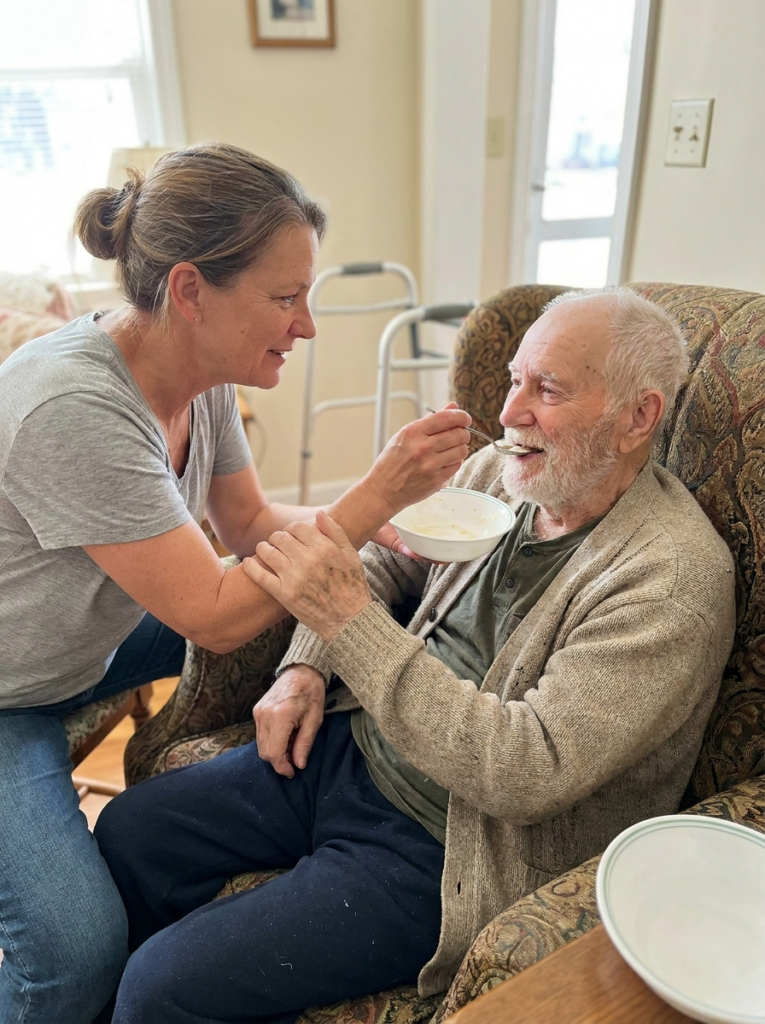
When Things Change: Recognizing the Active Dying Phase
The transition into the final hours to days of life has recognizable signs, and knowing them in advance reduces panic when they appear.
Physical signs of active dying include:
- Mottling: a purplish, blotchy discoloration of the skin, often starting in the knees and feet
- Cooling of the extremities even while the torso remains warm
- Changes in breathing: a pattern called Cheyne-Stokes breathing, which includes irregular rhythms, pauses, and deep gasping breaths
- The “death rattle,” which is not distressing to the person but is caused by secretions that can no longer be cleared
- Reduced or absent urine output, often with darkening color
- Eyes that are partially open but unfocused
- Jaw relaxation, sometimes with the mouth falling open
Your parent may be unconscious or semi-conscious during this time and still able to hear you. Hearing is thought to be one of the last senses to fade. Speaking calmly, offering reassurance, and simply being present matters, even when there is no visible response.
Call your hospice line when you notice these changes. They will walk you through what to expect and can send a nurse if needed. You do not have to navigate the final hours alone.
Practical Tasks to Manage Before and During Caregiving
End-of-life caregiving has an administrative layer that runs alongside the physical one. Getting these in order early prevents chaos at the worst possible time.
Documents to locate and organize:
- Healthcare Power of Attorney or Healthcare Proxy
- Living Will or Advance Directive
- POLST (Physician Orders for Life-Sustaining Treatment) — this should be posted visibly in the home
- Life insurance policies and the contact information for each insurer
- Financial account information and any existing will or trust documents
- Funeral preferences, whether written formally or discussed previously
For a comprehensive walkthrough of end-of-life planning documents, including what each one covers and how to ensure they’re legally valid in your state, see our full End-of-Life Planning Checklist.
After: The Grief That Comes When Caregiving Ends
Many caregivers describe a particular disorientation in the weeks after their parent dies. The structure that organized every hour. Medications, repositioning schedules, hospice visits. It all abruptly disappears. The phone doesn’t ring with nursing updates. There is nowhere specific to be.
This can feel like a second loss, layered over the first.
It is also common to feel relief, and then guilt about the relief. Relief is not a betrayal. It is a recognition that caregiving was hard, that watching someone you love suffer was hard, and that you are glad they are no longer suffering. Those feelings are allowed to exist alongside grief.
Hospice bereavement services typically continue for 13 months after a death and are often available at no cost to the family. If the hospice social worker or bereavement counselor reaches out to you, consider accepting the support. Many people don’t, and later wish they had.
Give yourself as much time as you gave caregiving. You have been through something significant. That doesn’t resolve on a predictable schedule.
This article is intended for general informational purposes and does not constitute medical or legal advice. Please work closely with your parent’s hospice or palliative care team for guidance specific to your situation.
